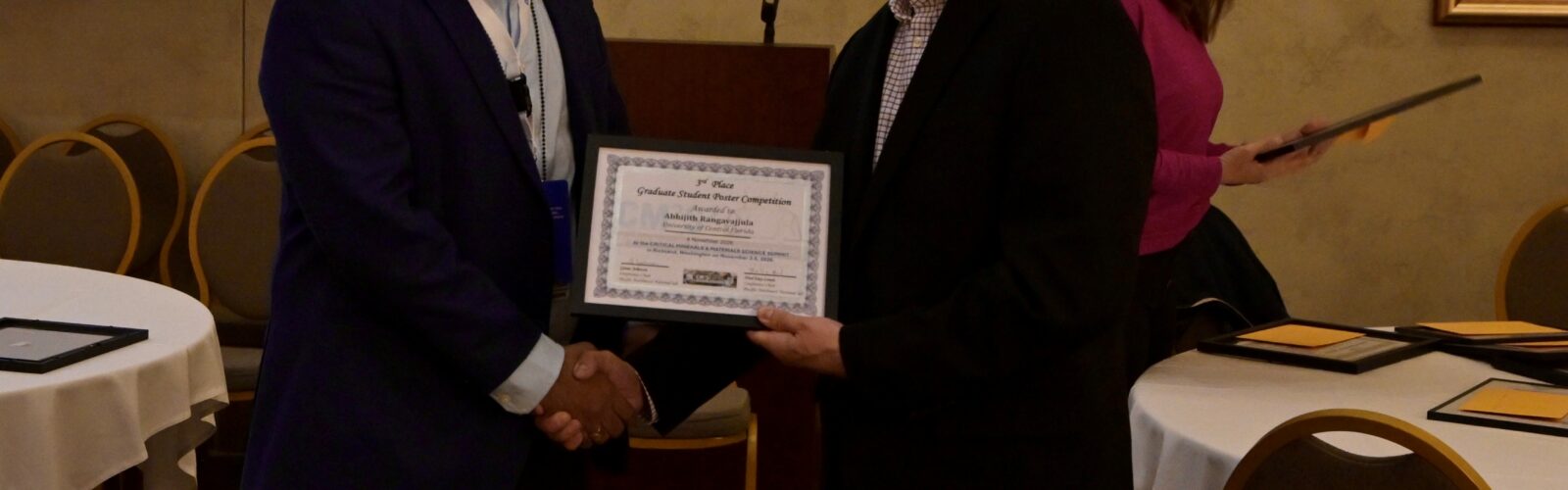
Rare earth elements (REEs) are essential materials for electronics, electric vehicles, wind turbines, jet engines and spacecraft guidance systems. Recovering REEs from discarded magnets and waste materials can result in large amounts of hazardous waste. But UCF materials science and engineering doctoral student Abhijith Rangavajjula has proposed a new solution that was recently recognized for its innovation.
Rangavajjula placed third in the Graduate Student Poster Competition at the 2026 Critical Minerals and Materials Science Summit for his research on REEs. The event is organized by the Pacific Northwest National Laboratory and the Pacific Northwest Chapter of the American Vacuum Society.
The UCF Knight says it feels both great and surprising to be recognized by a group of researchers from academic, industry and government.
“Placing third among the graduate student group tells me that the problem I work on matters, well beyond my own lab,” Rangavajjula says. “I am grateful to my advisor, Dr. Sudipta Seal, and to my mentors, whose guidance shaped this work.”
Seal says that Rangavajjula’s innovative work is a testament to his dedication to the field.
“Abhijith continues to push the boundaries of critical materials research through his curiosity, ingenuity and unwavering dedication,” Seal says.
Through his research, Rangavajjula has discovered that biphasic non-aqueous solvents can dissolve feedstock and separate the REEs, creating a cleaner method for recycling these materials.
Rangavajjula says the ability to solve engineering challenges like this, particularly under the guidance of world-renowned faculty, is the reason why he choose to study at UCF.
“I was drawn to materials science and engineering because it brings interdisciplinary sciences and engineering together to solve practical problems,” Rangavajjula says. “My interest began with energy storage materials and grew to include sustainable technologies more broadly, including the recovery of critical minerals. I chose UCF for its strong research environment and advanced facilities, and for the opportunity to do research with Dr. Seal.”
- Written by Marisa Ramiccio